
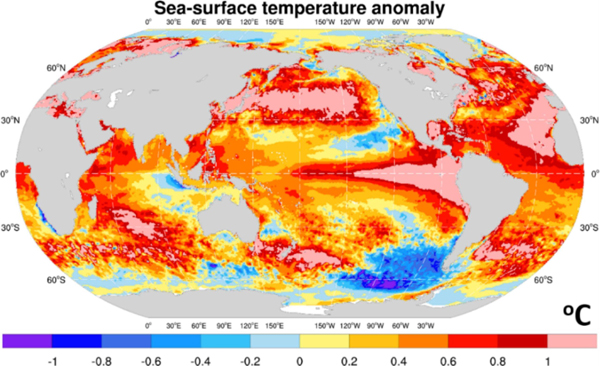
The world's oceans are warming at an unprecedented pace.
Over the past several years, scientists have observed exceptionally high sea surface temperatures across multiple ocean basins. These changes are more than isolated weather events—they are part of a broader warming trend driven by climate change.
Because the oceans absorb more than 90% of the excess heat trapped by greenhouse gases, even small increases in ocean temperature can have profound consequences for weather systems, marine ecosystems, sea-level rise, and global biodiversity.
Understanding why the oceans are warming has become one of the most important challenges in climate science.
The primary driver is the increase in greenhouse gases such as carbon dioxide and methane.
As these gases accumulate in Earth's atmosphere, they trap more heat that would otherwise escape into space.
While land temperatures respond relatively quickly, the oceans act as Earth's largest heat reservoir, slowly absorbing enormous amounts of excess energy.
This process helps moderate atmospheric warming but also leads to steadily increasing ocean temperatures.
Scientists estimate that the oceans have absorbed the vast majority of human-induced excess heat since the industrial era, making ocean warming one of the clearest indicators of long-term climate change.
Monitoring global ocean temperature requires an extensive network of technologies.
Researchers combine observations from:
These systems measure both sea surface temperatures and deeper ocean layers, providing a comprehensive picture of how heat is distributed throughout the world's oceans.
Long-term datasets allow scientists to distinguish natural climate variability from persistent warming trends.
One of the most visible consequences of rising ocean temperatures is the increasing frequency of marine heatwaves.
Marine heatwaves occur when ocean temperatures remain significantly above average for extended periods.
These events can last from several days to several months and affect ecosystems over vast geographic areas.
Marine heatwaves have been linked to:
Scientists expect these events to become more frequent as global temperatures continue to rise.
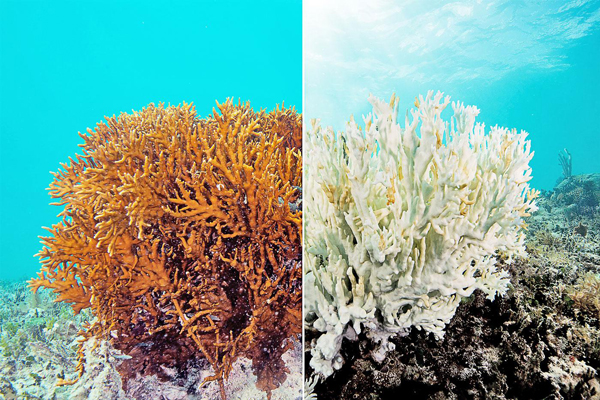
Coral reefs are among the ecosystems most vulnerable to warming oceans.
Corals live in partnership with microscopic algae that provide much of their energy through photosynthesis.
When water temperatures become too high, corals expel these algae, resulting in coral bleaching.
Although bleached corals are not immediately dead, prolonged heat stress greatly reduces their chances of survival.
Repeated bleaching events threaten reef biodiversity, fisheries, tourism, and coastal protection.
Ocean temperatures influence weather systems around the globe.
Warmer oceans provide additional energy that can intensify:
Higher sea surface temperatures also increase evaporation, adding more moisture to the atmosphere and contributing to more intense precipitation events in many regions.
Although no single storm can be attributed solely to climate change, warmer oceans create conditions that favor stronger and wetter extreme weather events.
Ocean warming contributes to sea-level rise in two important ways.
First, seawater expands as it warms, a process known as thermal expansion.
Second, warmer oceans accelerate the melting of glaciers and polar ice sheets.
Together, these processes increase global sea levels, placing greater pressure on coastal cities, wetlands, and island communities.
Even modest increases in sea level can significantly raise the risk of coastal flooding during storms.
The oceans have an extraordinary capacity to regulate Earth's climate, but recovery is slow.
Because seawater stores heat efficiently, the effects of today's greenhouse gas emissions may persist for decades.
Scientists emphasize that reducing carbon emissions remains the most effective strategy for slowing future ocean warming.
At the same time, protecting marine ecosystems through conservation, sustainable fisheries, and habitat restoration can improve resilience against climate-related stress.
Modern climate science relies on enormous volumes of observational data, computer simulations, and predictive models.
Communicating these complex datasets requires more than tables and technical reports.
Scientific illustrations, graphical abstracts, and data visualizations help researchers explain:
Clear visual communication enables policymakers, educators, and the public to better understand the science behind climate change and supports more informed decision-making.
Ocean warming is one of the strongest indicators of a changing climate.
Continued monitoring will help scientists improve climate models, predict extreme events, and guide adaptation strategies.
While the challenges are significant, advances in Earth observation, artificial intelligence, and climate modeling are providing unprecedented insight into how our oceans are changing.
Understanding these changes is essential not only for protecting marine ecosystems but also for safeguarding communities, economies, and future generations.
The warming of the world's oceans is reshaping Earth's climate in profound ways.
From marine heatwaves and coral bleaching to stronger storms and rising sea levels, ocean temperature has become one of the most important indicators of global climate change.
Continued scientific research, international collaboration, and effective science communication will be critical as researchers work to better understand—and respond to—our rapidly changing planet.
Anhui Province Academy of Science and Technology, No. 128,Wanshui Road, Hi-Tech Zone, Hefei City, Anhui Province, China
 +86 17354022649
 service@sondii.com


 IPv6 ПОДДЕРЖИВАЕМАЯ СЕТЬ
Наши часы
Пн, 21 ноября – Ср, 23 ноября: 9:00 – 20:00.
Чт, 24.11: закрыто. С Днем Благодарения!
Пт, 25 ноября: 8:00–22:00.
Сб 26.11 – Вс 27.11: 10:00 – 21:00
(все часы указаны по восточному времени)