July 9, 2026
Shuyu Wang¹²³ · Yanning Su¹⁴ · Yufeng Xu⁵ · Zhaoqi Wang¹²³ · Li Yao¹ · Yue Wu⁶ · Yanfei Hu¹ · Hongye Liu¹ · Junrong Kou⁵ · Peikai Li⁷ · Xingwei Wang¹ · Yuxin Li¹ · Lin Zhang¹ · Junyi Deng¹ · Lijun Wang⁸⁹ · Yun Huang¹⁰ · Jinfeng Wei¹¹ · Junhui Zhou¹¹ · Xiong You⁶ · Mian Zhou⁵¹² · Hang He¹⁴¹¹ · Wei Wang¹²³¹³
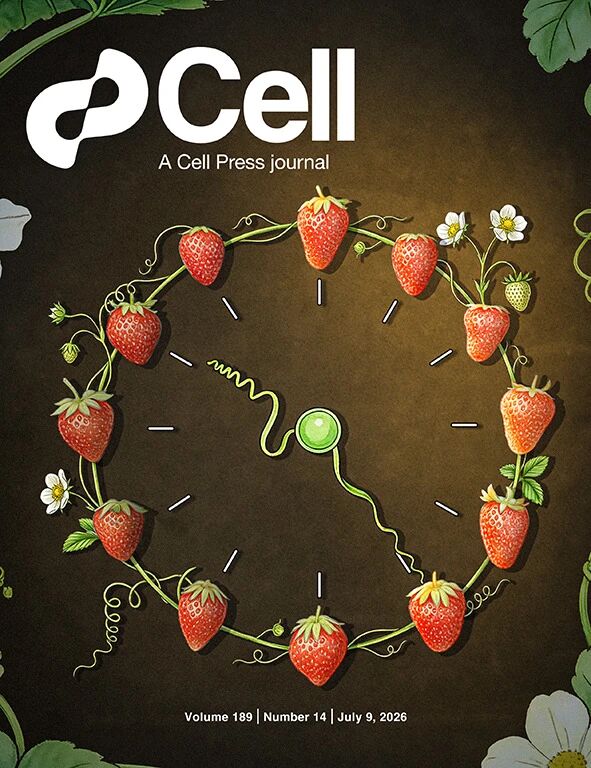
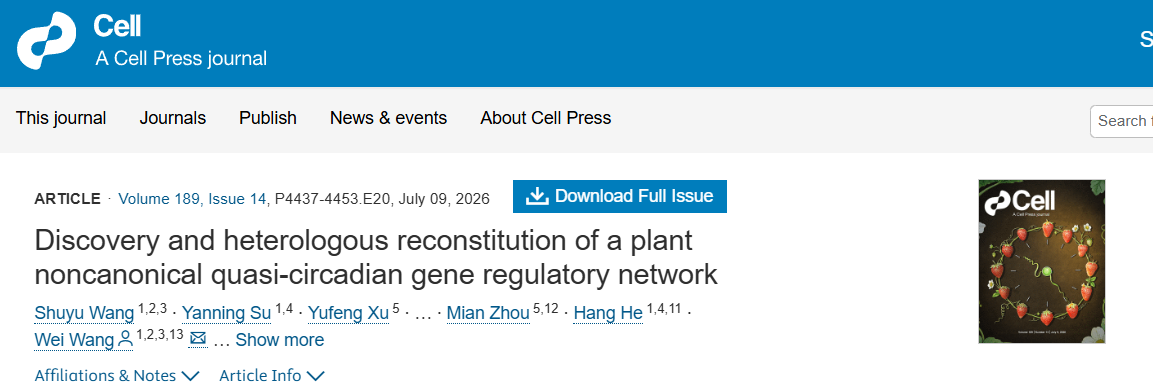
The cover of this issue of Cell features research from Professor Wei Wang's team at Peking University, titled “Discovery and Heterologous Reconstitution of a Plant Noncanonical Quasi-Circadian Gene Regulatory Network,” led by Shuyu Wang and colleagues.
Circadian rhythms are generally thought to be driven by gene regulatory networks composed of transcription factors. The prevailing view has been that only conserved “canonical” clock genes can generate rhythmic behavior.
Although plant and mammalian circadian clock networks share certain architectural features, their constituent genes differ substantially. This suggests that the ability to generate rhythmicity may not depend on a specific set of conserved genetic components.
Interestingly, postharvest strawberries can lose canonical circadian clock activity under cold-storage conditions while still maintaining rhythmic metabolic and physiological processes. This phenomenon challenges existing models of biological timekeeping and raises an important question: Could an alternative regulatory mechanism sustain rhythmicity in the absence of the canonical clock?
This study reports and experimentally validates, for the first time, a noncanonical quasi-circadian gene regulatory network supported by five previously uncharacterized transcription factors. The network independently maintains rhythmic outputs in postharvest strawberries during cold storage.
Using a heterologous reconstitution system, the researchers successfully reproduced the network's rhythm-generating capability in vitro. Combined with SELEX-seq, EMSA, and DAP-qPCR, the study further confirmed the direct regulation of downstream rhythmic genes by these transcription factors.
More importantly, disruption of this network significantly increased strawberry susceptibility to Botrytis cinerea, revealing its critical role in fruit immune defense.
These findings not only expand our understanding of the evolution and function of biological clocks, but also identify potential new targets for postharvest preservation and disease-resistant crop breeding.
Future research could investigate the conservation and species-specific characteristics of this noncanonical regulatory network across different plant species, as well as its dynamic interactions with environmental stresses such as low temperature and pathogen infection.
By integrating synthetic biology approaches, this regulatory module could potentially be transferred into other crops or microorganisms to establish artificial rhythmic systems for optimizing metabolite production or enhancing stress resistance.
Further characterization of the previously uncharacterized transcription factors and their molecular functions and interacting partners may also provide new theoretical foundations and practical tools for developing innovative postharvest preservation technologies and disease-resistant crop varieties.
The cover centers on the visual concept of a “strawberry clock,” seamlessly integrating biological rhythmicity with the natural morphology of the plant.
At the center of the composition, fresh strawberries, vines, and delicate flowers naturally form a circular clock face. The strawberries serve as hour markers, symbolizing units of time, while the winding vines function as clock hands. A central green dot represents the rhythmic pacemaker.
Through this visual metaphor, the composition conveys the study's central discovery: a noncanonical rhythmic regulatory network continues to operate in strawberries.
The background features a deep, earthy brown tone reminiscent of soil, creating a natural and grounded atmosphere while highlighting the vibrant reds of the strawberries and the rich greens of the leaves.
Water droplets on the strawberries and intricate leaf textures enhance the sense of realism and vitality. Meanwhile, the minimalist markings embedded within the clock face subtly suggest the precision of scientific measurement, creating a visual dialogue between nature and scientific rationality.
Rather than relying on conventional biological-clock imagery such as gears or DNA double helices, the design uses the plant itself to express the concept of rhythmicity.
This approach directly reflects the scientific theme while embracing the originality and artistic qualities valued by Cell.
We are proud to see another Sondii artwork recognized by the journal and featured on the cover of Cell!
Anhui Province Academy of Science and Technology, No. 128,Wanshui Road, Hi-Tech Zone, Hefei City, Anhui Province, China
 +86 17354022649
 service@sondii.com


 IPv6 ПОДДЕРЖИВАЕМАЯ СЕТЬ
Наши часы
Пн, 21 ноября – Ср, 23 ноября: 9:00 – 20:00.
Чт, 24.11: закрыто. С Днем Благодарения!
Пт, 25 ноября: 8:00–22:00.
Сб 26.11 – Вс 27.11: 10:00 – 21:00
(все часы указаны по восточному времени)